The question that delays more home purchase decisions in India than perhaps any other is not about location, price, or even size. It is this: which floor should I buy on?
Ask ten people and you will get ten different answers — often passionately held. Your mother will say low floor because of the lift. Your colleague will say high floor because of the view. Your building advisor will probably say mid floor because it is ‘the safest.’ And Google will give you a list of factors so long you will end up more confused than when you started.
This guide cuts through all of that. We are going to give you an honest, practical, Pune-specific framework for making this decision — one that accounts for lifestyle, health, resale value, and the specific character of a project like Probha Oasis in Manikbaug, Sinhagad Road.
Why This Decision Matters More Than Most Buyers Realise
In a multi-storey residential building, the floor you choose affects your daily life in ways that go far beyond the view. It affects:
- The quality and quantity of natural light in your home every day
- Indoor ventilation and air quality — critical for family health
- Noise levels from traffic, neighbours, and building common areas
- Your children’s and elderly parents’ daily mobility and independence
- The resale value and rental premium your apartment commands
- Your sense of privacy and the feeling of space inside your home
Get the floor choice right and it enhances your quality of life every single day. Get it wrong and it becomes a background source of friction that no amount of interior design can fix.
The Low Floor Reality: Honest Pros and Cons
What Works in Your Favour
Low floor apartments — typically floors 1 through 4 — have genuine advantages that are often undersold. If you have young children, elderly parents, or anyone in the family with mobility concerns, direct stair access is not just convenient — it is a genuine safety advantage. Medical emergencies, power cuts, and lift maintenance become far less stressful when you are three floors up rather than twenty.
Low floors also tend to have stronger water pressure in plumbing systems without booster pumps, and they typically have faster evacuation times in emergency situations. If the ground floor has a garden level, some low floor apartments in well-designed buildings also have semi-private outdoor spaces.
The Challenges You Need to Know
The trade-offs are real. Lower floors receive less natural light, particularly in buildings that are close to adjacent structures or have a podium design. Street noise penetrates more easily. In Pune’s heavy monsoon season, flooding and waterlogging risk — while manageable in well-constructed buildings — is concentrated in ground and lower floors. And in resale markets across Pune’s established corridors, low floor apartments consistently fetch 5–10% lower prices than equivalent mid-to-high floor units.
The Mid Floor Sweet Spot: Who It Actually Works For
Floors 5 through 10 in most Pune residential buildings represent a reasonable compromise — enough height to escape significant street noise, enough natural light for comfortable living, and lift-independent access still feasible in most situations. For families without specific high-floor preferences and without elderly members who avoid lift dependence, mid floors are a practical choice.
The honest caveat: ‘compromise’ is not always a virtue. If a project’s primary differentiator is its upper-floor panoramic views — as is the case with Probha Oasis’s hillside Manikbaug location — choosing a mid floor to save a small price differential may mean forgoing the apartment’s most significant lifestyle and resale premium.
High Floors and Panoramic Views: Beyond the Obvious
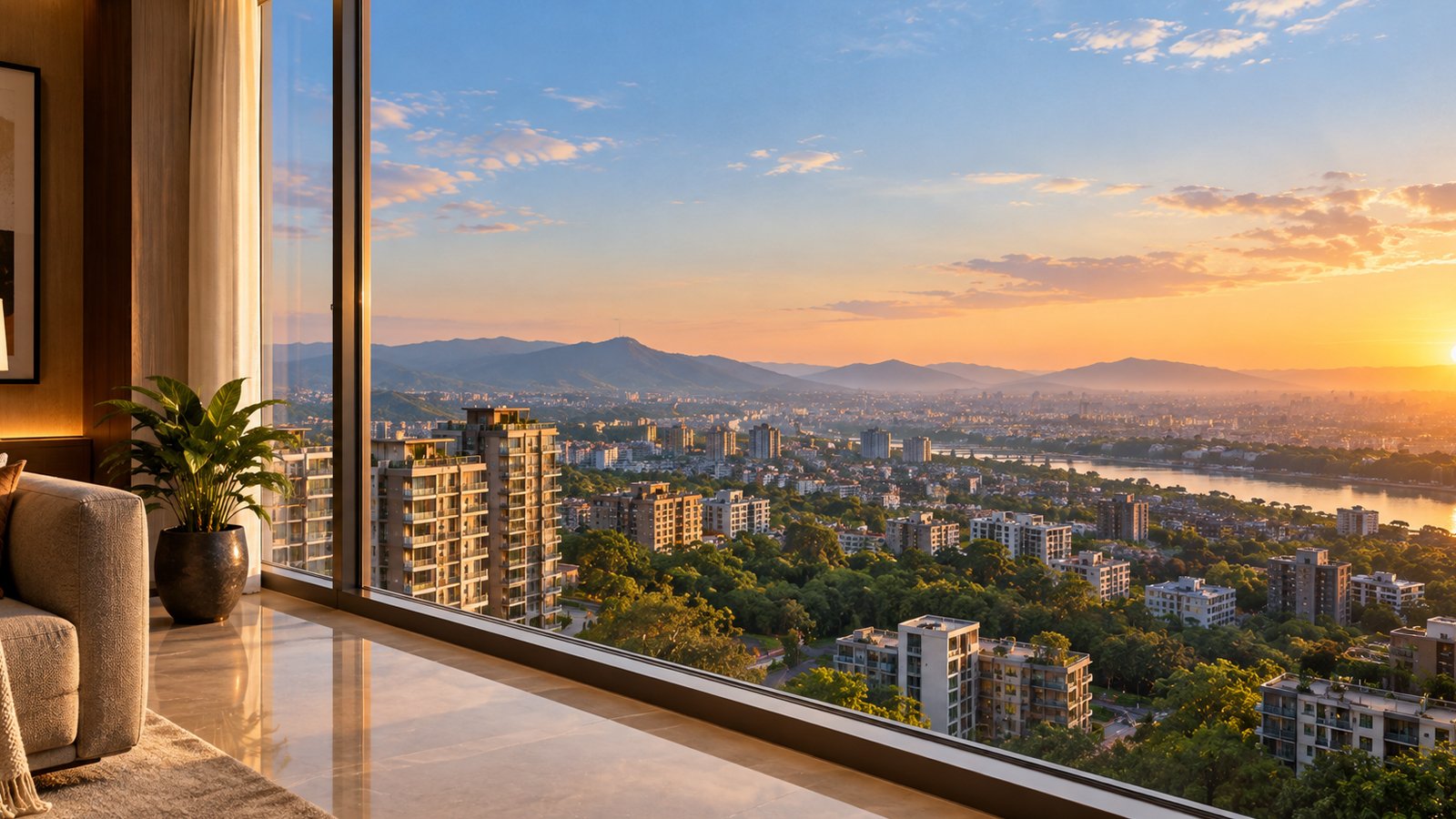
The conventional wisdom about high floors focuses on the view. The view is real and significant — particularly in a project like Probha Oasis where the Sinhagad Road elevation creates genuine panoramic visibility of Pune’s skyline that mid-rise buildings in flatter parts of the city cannot replicate.
But experienced buyers know that the view is actually one of several compounding advantages:
Natural Light — The One That Changes Daily Life Most
High floor apartments in Pune’s residential buildings typically receive 40–60% more usable natural light than equivalent low floor units in the same building. This means lower electricity consumption from artificial lighting, significantly better indoor air quality from UV penetration, and a measurably different psychological quality to everyday living. Rooms feel larger. Mornings feel better. These are not small things when you are choosing where you will spend twenty years.
Ventilation and Air Quality
At higher elevations, cross-ventilation is more consistent and more effective. In a city with Pune’s air quality profile — considerably better than India’s northern metros but still subject to urban particulate levels — height provides a meaningful air quality advantage, particularly in the green belt corridor of Sinhagad Road where prevailing winds from the Sahyadri range create natural air circulation.
Noise Reduction
Road noise drops significantly above floor 8–10 in most Indian urban environments. In a project on a 120-Feet DP Road like Probha Oasis, this difference becomes even more pronounced. The premium you pay for a higher floor is in part the premium for quieter nights, undisturbed morning routines, and the ability to keep windows open without the city’s acoustic landscape filling your home.
The Resale Premium — Numbers That Matter
Across Pune’s established micro-markets, upper floor apartments with view corridors have consistently commanded resale premiums of 8–15% over equivalent lower floor units in the same building. In hillside locations with genuine panoramic views — like Manikbaug — this premium can be higher. The buyer who pays a modest additional amount for a higher floor during the original purchase is essentially buying a resale premium that compounds with overall market appreciation.
The Pune Context: What Our Market Actually Tells Us
In Pune’s established residential micro-markets — Kothrud, Baner, Kalyani Nagar, and the Sinhagad Road corridor — resale data consistently validates the high floor premium. Properties with documented city or landscape views sell faster and at higher per-square-foot rates. The demographic profile of buyers in these markets — IT professionals, HNIs, NRIs — places significant value on light, air, views, and the status of an elevated address.
For Probha Oasis specifically, the Manikbaug elevation creates a natural view advantage that cannot be replicated by a building on flat ground regardless of how many floors it has. The hillside topography means that even mid-height floors in the project have view angles that a 20-storey building in central Pune cannot match.
So Which Floor Should You Actually Choose?
Here is the honest framework:
- Choose a low floor if: You have elderly residents or mobility challenges in the family, and lift independence is a daily priority.
- Choose a mid floor if: Budget is the primary constraint and you want a practical balance of light, noise, and accessibility.
- Choose a high floor if: You are buying for the long term, you value natural light and ventilation in daily living, you want the strongest resale position, and you have the opportunity to secure a genuine view corridor — as exists at Probha Oasis, Manikbaug.
The most expensive floor in a building with a panoramic city view will almost always outperform the cheapest floor in a comparable building over a 7–10 year horizon. That is not a sales pitch. That is a pattern that runs consistently across Pune’s resale data.
Frequently Asked Questions
Which floor is best to buy in a high-rise apartment in Pune?
The best floor depends on your family’s needs. For maximum natural light, ventilation, noise reduction, and long-term resale value, upper floors consistently outperform in Pune’s residential market. If mobility or lift-independence
Do high floor apartments in Pune command better resale value?
Yes. Across Pune’s established micro-markets, upper floor apartments with view corridors consistently fetch 8–15% higher resale prices than equivalent lower floor units in the same building. View, light quality, and noise reduction drive this premium.
Is a panoramic view worth paying extra for in a flat?
In most cases, yes — particularly in hillside locations like Manikbaug on Sinhagad Road where the view is structural and cannot be blocked by future construction. Views that are protected by topography or open land buffers represent a durable premium rather than a temporary aesthetic advantage.
What floors are available at Probha Oasis, Manikbaug?
Probha Oasis offers 2 and 3 BHK apartments across multiple floors. To understand specific floor availability, pricing, and view corridors by floor, we recommend booking a personal show flat visit where our team can walk you through the options in detail. Call 8087444334 for current availability.
Stop deciding by spreadsheet. Come see the difference a floor makes in person. Probha Oasis Show Flat is ready — experience the natural light, the ventilation, and the panoramic views that make the floor choice obvious. Call / WhatsApp: 8087444334 | 8087444332 | Book your site visit at www.probhaoasis.com