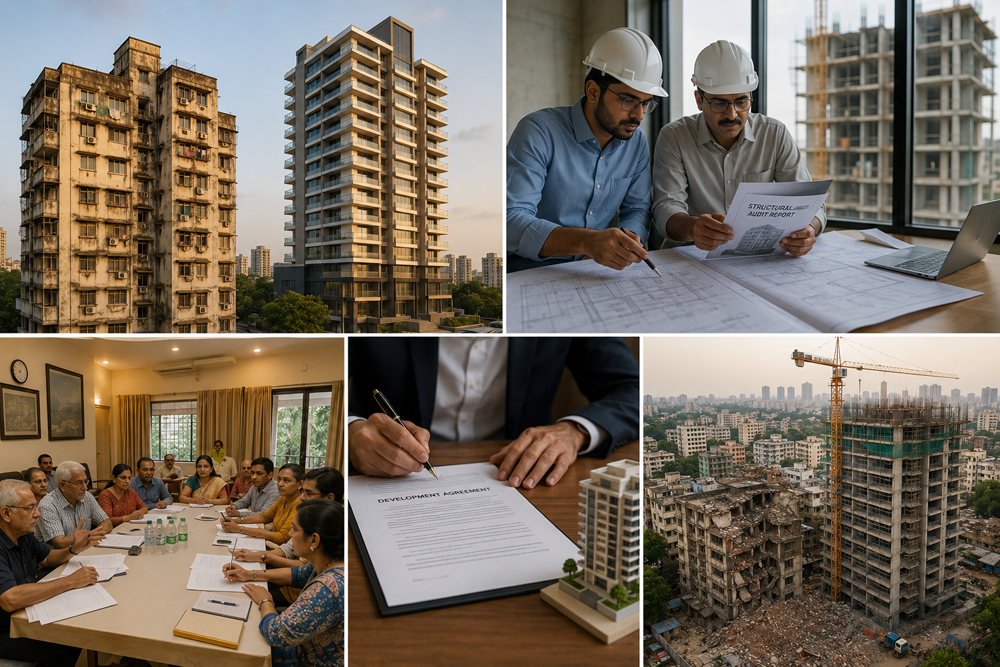
If you live in an ageing housing society in Kothrud, Erandwane, Aundh, or Bibwewadi, chances are the word “redevelopment” has come up at your last general body meeting. For many committee members and residents, it’s an exciting idea — and a confusing one. Should you repair the building for another decade, or redevelop it entirely?
This guide breaks down what redevelopment actually means, what it offers your society, and the questions you should be asking before your society votes.
What Is Housing Society Redevelopment?
Redevelopment is the process where an old, structurally weak, or space-inefficient building is demolished and rebuilt — usually with more floors, modern amenities, and additional saleable area — by a developer, in exchange for a share of the newly constructed units and, often, a corpus fund for existing members.
In simple terms: your society gets a brand-new building, upgraded amenities, and often a larger carpet area than before — without members paying construction costs out of pocket.
Why Are So Many Pune Societies Choosing Redevelopment in 2026?
Several factors are driving redevelopment activity across Pune’s older, well-located neighborhoods:
Ageing structures. Many buildings in Kothrud, Erandwane, and Bibwewadi are 30-40 years old, built before modern earthquake-resistant codes existed. Structural audits in these areas increasingly recommend redevelopment over repair.
Rising land values. As these localities have become more central and connected, land values have risen sharply — making redevelopment financially attractive for both developers and society members.
Demand for modern amenities. Today’s homebuyers expect elevators, parking, security systems, clubhouses, and open spaces — features most older buildings simply don’t have.
Additional carpet area. Under current Pune Municipal Corporation regulations, redevelopment often allows societies to unlock significantly more FSI (Floor Space Index) than the original structure used, meaning more space for the same footprint.
Redevelopment vs. Repair: Which Makes More Sense?
This is the question every committee eventually faces. Here’s a simple way to think about it:
Choose repair if: your structural audit shows the building is structurally sound, your society doesn’t need significantly more space, and members strongly prefer to avoid the temporary relocation that redevelopment requires.
Choose redevelopment if: the structural audit flags the building as weak or unsafe, members want larger homes or modern amenities, or the society wants to unlock the value of unused FSI and generate a corpus fund.
Repair is cheaper upfront but is essentially a temporary fix — it doesn’t solve space constraints, ageing plumbing/electrical systems, or lack of parking. Redevelopment is a bigger decision, but it resets the clock on all of these issues at once.
The Redevelopment Process: Step by Step
- Structural Audit — A certified structural engineer assesses the building’s condition and lifespan.
- General Body Resolution — Members vote (typically requiring 51-75% consent depending on the redevelopment scheme) to proceed.
- Developer Selection — The society issues a tender, evaluates proposals, and selects a developer based on offer, track record, and financial stability.
- Development Agreement — Terms including additional area per member, corpus fund, rent during construction, and timelines are legally documented.
- Approvals — The developer secures PMC and RERA approvals for the new building plan.
- Construction & Handover — Members relocate temporarily, construction proceeds, and new units are handed over per the agreement.
What to Verify Before You Sign
Before any society commits to a developer, members should independently verify:
- The developer’s RERA registration and track record on past redevelopment projects
- Financial stability — has the developer completed similar projects on time?
- Clear terms for rent during the transition period and what happens if there are delays
- The exact carpet area, floor, and amenities being offered per member, in writing
Why Experience Matters in Redevelopment
Redevelopment isn’t a typical construction project — it involves managing dozens of families’ homes, expectations, and legal rights simultaneously. A developer with a genuine track record in Pune redevelopment (not just new residential launches) understands the sensitivities involved: transparent communication with the general body, realistic timelines, and fair, well-documented agreements.
With over four decades in Pune’s construction landscape, Probha Group has worked directly with housing societies across Kothrud, Erandwane, Aundh, Bibwewadi, and Pimpri-Chinchwad to guide them through this exact process — from the first structural audit conversation to final handover.
If your society is exploring redevelopment, the most important first step is an honest, professional assessment of your building — not a sales pitch.